
Your Energy Source


Your Energy Source
 
A properly designed Heating and Cooling system means Comfort
 
Comfort and Health
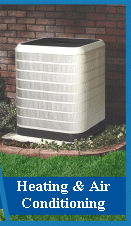
Is the comfort of your home important to you? Today's heating and cooling systems are more comfortable than ever before. They are quieter. They maintain temperatures better. They know when you want them to run. They can control correct humidity levels. They can heat and cool specific sections of your home. They can even filter your indoor air for better health and help against allergies and asthma.
 
Your Energy Source
 
Energy Savings
Heating and cooling a home also costs the average homeowner about $600 a year - about half of the home's total energy costs. You can easily cut those costs with today's high efficiency heating and cooling systems. And with energy prices expected to continue their dramatic rises, future savings will be even greater. If your current heating and cooling system is older than 15 years, it could actually pay you to upgrade.
 
 
Environmental Benefits
If just one in 10 households bought ENERGY STAR heating and cooling equipment, the change would keep over 17 billion pounds of pollution out of the air. New efficient units also use environmentally refrigerants approved by the EPA, such as Puron, whereas if your system was installed prior to 2000 it most certainly uses Freon, which is being banned by the federal government.
 
 
Your Energy Source
Before
Your Energy Source
After
 
Your Energy Source
Before
Your Energy Source
After


Your Energy Source
 
Indoor Air Quality means Health and Quality of Life
 
Comfort and Health
Are concerned about the air you breathe? A study conducted by the U.S. Environmental Protection Agency (EPA) found that indoor exposure to harmful air pollutants can be up to 70 times more polluted than the outdoor environment. Given we spend up to 90% of our time indoors, it is no wonder the EPA now classifies Indoor Air Quality as one of our most important environmental concerns.

Since the volume of air indoors is also much smaller than outdoors, a molecule of pollution inside is more apt to be inhaled than a molecule of pollution outside. Researchers have concluded that indoor emissions are 1,000 times as likely to be inhaled by a person - even if the amount of emissions inside is much smaller than outside.
 
Types Of Indoor Air Pollutants
The Centers for Disease Control and Prevention (CDC) places air pollutants into three general categories:
 
Your Energy Source
 
Particulates- Particulates include dirt, dust, fibers, tobacco smoke particles and fireplace or wood stove soot.
 
Bioaerosols- Bioaerosols are particulates from living matter such as bacteria, molds and fungi, dust mite and insect remains, pet dander and pollens.
 
Volatile Organic Compounds- VOCs include potentially harmful or irritating derivatives of alcohols, ketones, hydrocarbons and aromatics, such as formaldehyde or benzene. VOCs are often created from "off-gassing" of man-made materials such as carpeting, composite wood products and household chemicals.
 
 
What are Common Symptoms of Poor Indoor Air?
According to the American Medical Association, 50% of all illness is caused or aggravated by polluted indoor air. Symptons include allergies, asthma, bronchitis, dizziness, headaches, eye irritation, sinus irritation, migraines, nausea, coughing, fatigue, and more.
 
Home Indoor Air Quality Check List
If you can answer yes to two or more of the following questions, you may want to take steps to improve the IAQ of your home:
  • Does anyone in your family suffer from allergies, asthma or other respiratory problems?
  • Do they notice that their symptoms (headaches, fatigue, nasal congestion, sore throat, etc.) are worse at night or in the morning?
  • Does any family member have immune system problems or illness?
  • Do you have an infant child or elderly family member?
  • Is there a smoker in the house?
  • Are there any pets?
  • Do you notice a stale or musty odor when the furnace or air conditioner runs?
  • Do you notice dust on furniture shortly after cleaning?
  • Is your home new?
  • Is your home more than 10 years old?
  • Does dirt or dust accumulate on your supply or return air grills?


Your Energy Source
 
The Future of Water Heaters
 
The Future of Water Heaters- What is it?
Tired of running out of Hot Water? Tankless Water Heaters, also known as Continuous Flow Water Heaters, are the wave of the future. They never run out of hot water, they save space, and they save energy. Sound too good to be true?
 
Your Energy Source
 
Benefits
The number one reason cited for choosing a Tankless Water Heater is endless hot water. Can't fill up that sauna tub? Tired of running out of hot water after the last person just showered?

Tankless Water Heaters are a fraction of the size of traditional water heaters and can even be moved outdoors. Need some extra space?

Heating water accounts for 15% of total residential energy usage. With high efficiencies of 80-85%, Tankless Water Heaters can reduce water-heating costs up to 50%.


How Does It Work?
Conventional water heaters heat water 24 hours a day for those brief moments when you need hot water. That is sort of like boiling running the coffee pot all day for that cup of coffee you will drink tomorrow morning. Doesn't make a lot of sense, does it? By comparison, Tankless Water Heaters heat the water instantantly with powerful yet efficient burners as the water passes through the pipes, so it only uses energy when hot water is demanded. And since it heats the water as it passes through, you can even fill a bath tub without running out of hot water.
 
Your Energy Source


Your Energy Source
 
Your View to the Outside World.
 
A View to Your World
Does your home need a makeover? New windows and doors not only are your view to the world, they personify your home. What better way to dress up and increase the value of your home than with new windows to meet any style you desire. Modern windows come in unlimited styles, materials, frames, shapes, sizes, glass, and grid patterns. If you can dream it, we can install it.
 
Comfort
On a cold winter day, do you ever feel the cold air and wind sneaking into your home? Or on a hot summer day, do you ever wonder why your air conditioner can't keep out the heat? Old windows are a major cause of energy loss. New windows can remedy those drafts and make you comfortable. In fact, high efficient windows, doors and skylights can help reduce your heating and cooling bills up to 25% by reducing heat transfer. You should consider replacing your windows if your home has single-pane windows (as half of U.S. homes do), dual-pane windows with moisture, or windows older than 15 years.
 
Modern Technology
If you have older windows, you might be surprised how much window technology has improved. New frame materials and glass coatings have combined to make modern dual pane windows nothing like their predecessors. Today's windows have special coatings built into the glass that greatly reduces heat gain and heat loss:
 
Your Energy Source
 
1. Special glass allows most natural light to enter freely but absorbs a significant portion of short-wave heat energy.

2. In the summer, long-wave heat energy radiating from objects is reflected back outside, lowering cooling costs.

3. In winter, internal long wave heat energy is reflected back inside, lowering heating costs.
 
 
Your Energy Source
Before
Your Energy Source
After
 
Your Energy Source
Before
Your Energy Source
After
 
Your Energy Source
Before
Your Energy Source
After


Home  |   Services  |   Products  |   Energy Star  |   Portfolio  |   Testimonials  |   Incentives  |   About Us  |   Contact Info
copyright @ 2007 YES | Designed & Powered By: Everycontractor.com